Be calm.
Anytime, Anywhere.
Role: UX Designer and Researcher
Duration: 3 Weeks
SteadyMind EMDR is a self-directed bilateral stimulation tool designed to support emotional regulation and calm for mental health clients outside of clinical sessions. The concept originated from direct clinical observation at a rehabilitation center and was later validated through client feedback at SonderMind, a mental health platform serving clients across all 50 states. This case study documents the research behind the concept, the design decisions that shaped it, its proposed integration into existing mental health platforms and as a standalone app - making it as accessible as possible across every point of entry.
Origin
While working at Success Rehabilitation, I observed that clients with traumatic brain injuries frequently experienced sudden onset emotional dysregulation - rage, frustration, and distress that disrupted therapy sessions and daily functioning. Case workers were manually guiding clients through EMDR to help regulate these responses, which required one-on-one attention and was limited to scheduled appointments.
I proposed building an app that could extend this support beyond clinical sessions, giving clients access to bilateral stimulation on demand. A relocation ended my time there before the concept could move forward, but the idea stayed with me.
-
At SonderMind, the same access gap appeared in a different form. Clients frequently requested EMDR as part of their care, but providers with that specialty were not always available within their match options. The need was real and recurring - clients wanted a tool they could use independently, between sessions, without requiring a specialty-trained clinician to be present.
That pattern confirmed that the problem was not specific to TBI patients. It was a broader access issue affecting mental health clients across populations and diagnoses. A self-directed bilateral stimulation tool, designed thoughtfully for accessibility and emotional safety, could meaningfully extend the support available to any client on the platform.
-
Existing bilateral stimulation platforms like Bilateral Base and remotEMDR are built as professional clinical tools for EMDR-trained therapists. Both platforms are therapist-controlled - the clinician manages the session while the client participates under their guidance. They are priced for clinical practice, used by tens of thousands of therapists worldwide, and trusted by organizations including the NHS, the US Department of Defense, and the World Health Organization. They are excellent at what they do.
But they were not built for the client acting alone.
A client who cannot find an EMDR-trained provider, who needs support at 2am between sessions, or who simply wants access to bilateral stimulation on their own terms has no self-directed option designed with them in mind.
SteadyMind fills that gap. It is designed for the client - not the clinician. No therapist required, no appointment, no referral, no subscription. Just bilateral stimulation, accessible to anyone who needs it, whenever they need it.
This distinction is intentional and clinically honest. SteadyMind is not a replacement for therapist-led EMDR. It is support for everyone the existing tools were never built to reach.
Design Decisions
-
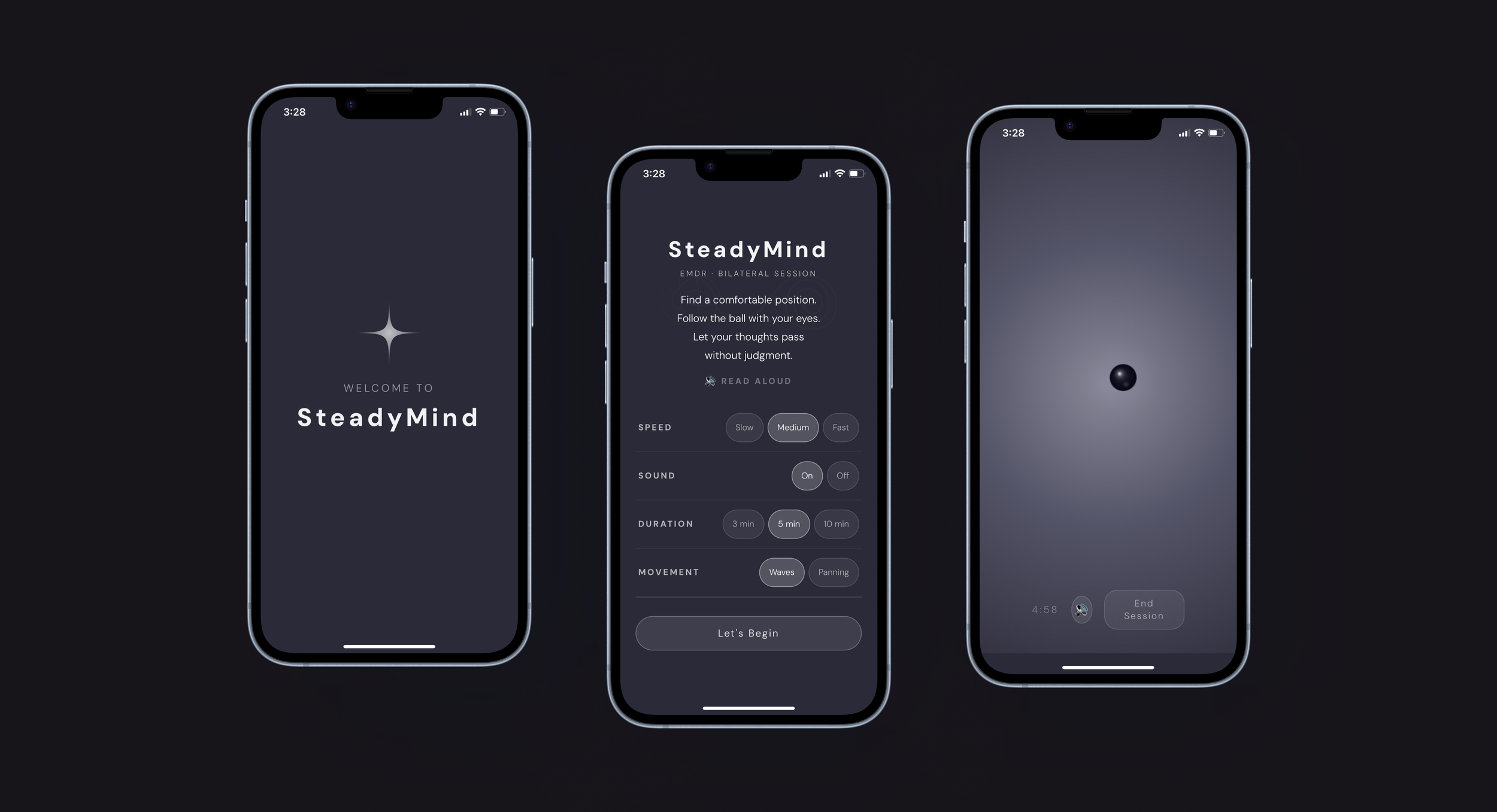
The bilateral stimulus is a dark, glossy sphere with a metallic shimmer that travels across the screen at a steady pace. The aesthetic is intentional — grounded and weighted rather than bright or clinical, suited to a tool accessed during moments of emotional distress.
Before beginning a session, users configure four settings: Speed (Slow, Medium, or Fast), Sound (On or Off), Duration (3, 5, or 10 minutes), and Movement (Waves or Panning). Waves follows a gentle arcing path; Panning moves the sphere in a direct, horizontal line. These choices are made upfront so the session itself is uninterrupted.
-
The intro screen displays three plain-language instructions: "Find a comfortable position. Follow the ball with your eyes. Let your thoughts pass without judgment." A Read Aloud option plays a voice recording of those instructions.
-
Brown noise plays continuously throughout the session, alternating between left and right audio channels in sync with the sphere's movement to create bilateral auditory stimulation. Headphones or stereo speakers are recommended. Sound can be toggled before the session begins and muted during the session without interrupting the experience.
-
During the session, a timer and a mute button are accessible at the bottom of the screen. The End Session button is always visible. On exit, the screen reads: "Well done. Take a moment before you continue." The user then chooses between "Done for now" or "Begin another session." There is no performance metric, no prompt to continue, and no friction on exit.
Early User Testing
SteadyMind was shared with a small group of people navigating genuinely stressful periods in their lives. A first-time parent managing the demands of a newborn incorporated SteadyMind into their daily routine, using it to settle their nervous system during high-stress moments — when the baby had been crying for hours, or when they needed to decompress before sleep. They continue to use it regularly.
A college student managing the pressure of finals used the tool throughout the exam period, reporting reduced anxiety and improved focus. They named SteadyMind as their primary source of calm during that stretch.
Proposed Integration
SteadyMind is designed to function both as a standalone app and as an embedded feature within existing mental health platforms. As a standalone product, it serves anyone seeking an accessible, self-directed bilateral stimulation tool - no provider relationship required. Within a platform like SonderMind or similar, it would live on the client home screen as an always-available resource, accessible to any user at any time without requiring a provider to assign or activate it. This positions it as a between-session support tool rather than a clinical intervention, keeping it within appropriate scope for self-directed use.
In a future state, providers on any platform could optionally recommend the tool to clients as a between-session practice, with the client choosing whether to engage. No session data would be shared with providers without explicit client consent, preserving autonomy and trust.
Future State
The next phase of SteadyMind centers on listening before building. Through research, surveys, and continued user feedback, the goal is to understand what users actually need from the tool - what works, what falls short, and what would make it more effective for different populations and contexts. No features will be added or removed without that foundation.
One area worth exploring is VR integration. A fully immersive bilateral stimulation environment could deepen the experience for users with headset access. Whether that becomes a meaningful direction depends on what the research supports.
Above all, SteadyMind is intended to be a tool for anyone - regardless of background, ability, or familiarity with mental health resources. Every future decision will be held against that standard.