SonderMind: Writing for High-Stakes Moments
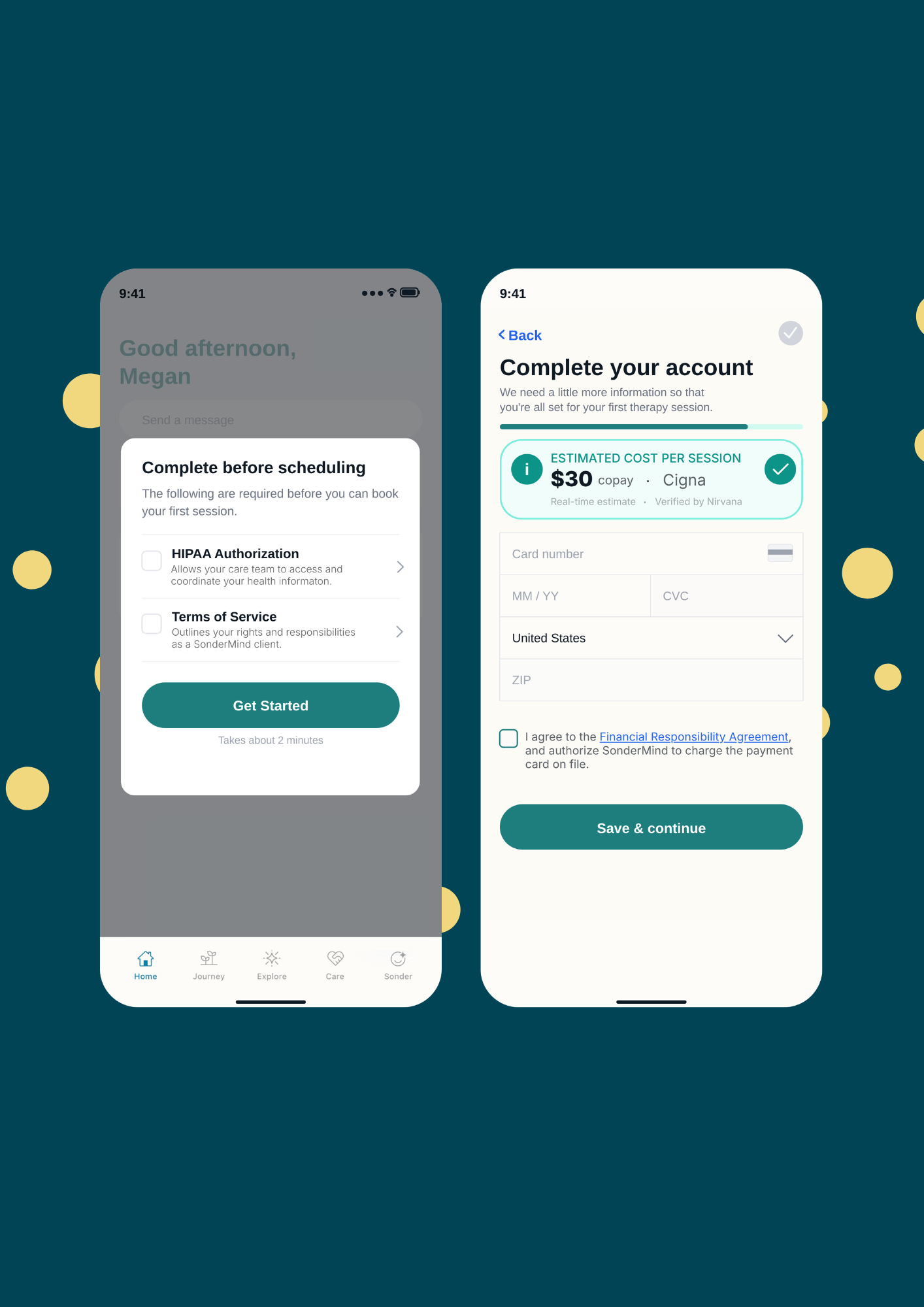
SonderMind is a mental health platform connecting clients with licensed therapists across all 50 states. During a redesign of the client onboarding flow, three distinct pieces of writing required careful decisions: the attestation modal presented at login, the Nirvana insurance estimate card, and the Financial Responsibility Agreement checkbox. Each piece carried legal weight, lived in a high-anxiety moment for the user, and needed to communicate clearly without creating fear or confusion.
Challenge 1: Attestation Modal
The modal appeared immediately after a client logged in for the first time, before they could proceed with onboarding. It asked them to review and sign two legally required documents: a HIPAA Authorization and a Terms of Service agreement. The writing needed to explain what each document was, why it was required, and what signing it meant — without sounding like a legal wall that made users want to close the app.
The Decisions
The document descriptions went through several considerations. "HIPAA Authorization" as a label risks meaning nothing to a client who has never navigated healthcare paperwork. The supporting description needed to translate it into plain human terms without being condescending or alarming.
Rejected: "This document is required by federal law before care can begin." This is accurate but leads with obligation rather than meaning. It tells the user what they have to do, not what the document does for them.
Chosen: "Allows your care team to access and coordinate your health information." This frames the document as a tool that serves the client's care, not a legal hurdle they must clear. The word "allows" gives the client agency. "Your care team" is warm and personal. "Coordinate" implies active support, not passive data collection.
For Terms of Service the same principle applied. Rather than defaulting to "legal terms and conditions," the description was written to tell the user exactly what the document covers in their context.
Chosen: "Outlines your rights and responsibilities as a SonderMind client." "Your rights" comes before "responsibilities" deliberately. Leading with what the client receives rather than what is expected of them reduces defensiveness at a vulnerable moment in the onboarding flow.
The modal headline - "Complete before scheduling" - was chosen over alternatives like "Action required" or "Before you get started" because it is outcome-oriented. It tells the user exactly what completing this step unlocks, which reduces friction by making the payoff visible.
Challenge 2: Nirvana Insurance Estimate Card
The billing screen required a new element: a card surfacing a real-time copay estimate before the client entered payment information. The card needed to reassure users - particularly those aged 40 to 80 who research identified as most likely to abandon at this step due to financial uncertainty - without over-promising or creating liability.
The Decisions
The headline went through two rounds of consideration.
Rejected: "Your copay" Too blunt. Reads as a bill rather than helpful information. "What you might pay" The hedge ("might") creates uncertainty rather than reducing it.
Chosen: "Estimated cost per session" - "Estimated" is honest without being alarming. "Per session" is specific and sets expectations clearly. The word "cost" is more neutral than "charge" or "bill."
The supporting line - "Real-time estimate · Verified by Nirvana" - does two things simultaneously. "Real-time" signals that the number is current and relevant to their specific plan, not a generic range. "Verified by Nirvana" borrows credibility from a third-party source, which research showed mattered to users with financial fraud concerns.
Challenge 3: Financial Responsibility Agreement - In Progress
The FRA checkbox at the bottom of the payment screen links to the full legal document. The formal name and link will remain — removing it would obscure what the client is agreeing to, which creates its own kind of anxiety. The work currently in progress focuses on adding plain-language context throughout the onboarding journey so clients arrive at the FRA already understanding what financial responsibility means in practice at SonderMind, rather than encountering the concept for the first time at the point of payment.
The Outcome
Repositioning the attestation documents drove a team-reported increase in completion rates over a four-week period. Billing step completion in the 100-client cohort rose from 21% to 29% after FRA visibility improvements. Full Nirvana integration is projected to bring that figure above 60%. FRA plain-language improvements are ongoing.