Redesigning SonderMind's Client Onboarding
SonderMind is a mental health platform serving clients across all 50 states through a network of more than 12,000 licensed clinicians. This case study covers two structural changes I identified, researched, and proposed within the client onboarding flow.
Role: UX Designer and Research | Duration: 4 months
Research, design, journey mapping, competitive analysis, prototyping, stakeholder communication

The Problem
Client onboarding at SonderMind required completing two legally required documents before a session could be scheduled: a HIPAA Authorization and a Terms of Service agreement. Both documents were positioned at the end of the onboarding flow, after clients had already entered their demographics, insurance information, and payment details.
A second, separate issue existed within the payment step. Clients were asked to enter a payment method and agree to a Financial Responsibility Agreement without any prior information about what they would actually be charged. The agreement linked to the full terms document but provided no plain-language cost estimate at the point of entry.
Research and Discovery
To understand the payment friction more specifically, I ran a structured test with 100 clients moving through the billing step. Twenty-one completed it. I identified three contributing factors: clients did not know what they would owe, the Financial Responsibility Agreement was presented as a legal link with no summary, and clients in the 40 to 80 age range expressed concern about entering financial information without understanding the terms first. Competitive analysis of Headway, Rula, and Grow Therapy confirmed that cost transparency before payment entry was a common pattern among SonderMind's direct competitors.
I conducted client interviews and mapped the end-to-end onboarding journey to locate where clients were disengaging and why. Drop-off data pointed to two distinct failure points: the attestation step at the end of onboarding, and the payment entry screen.

Solution 1
Attestations First
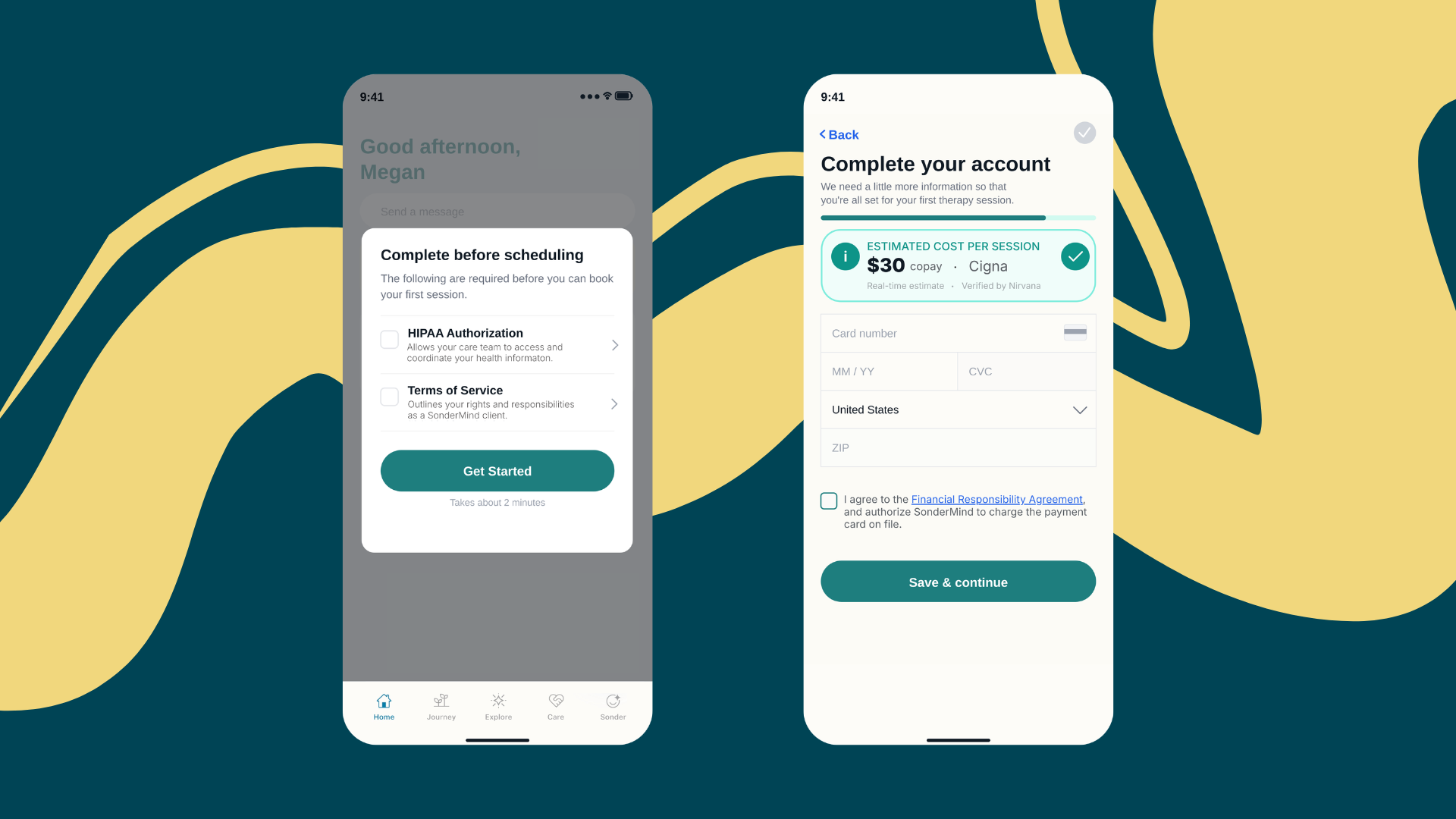
I proposed moving both required documents to the entry point of onboarding rather than the end. The redesign introduced a modal that appeared immediately after login, before the client began completing their account. The modal presented both documents as discrete checklist items with brief plain-language descriptions of what each one authorized. Clients could not proceed without completing both.
Repositioning the attestation documents contributed to a meaningful increase in client completions, reducing a critical drop-off point identified through direct user research.
Solution 2
Nirvana Benefit Verification
I proposed integrating Nirvana, a real-time insurance benefit verification platform used by more than 11,000 healthcare providers, into the payment step. The integration would surface a client's estimated copay before they entered payment information, based on their verified insurance plan.
In the current flow, after the FRA link was made more visible, test completion rose from 21% to 29%. The Nirvana estimate card, shown directly above the payment form, is projected to push completion above 60% by giving clients the information they need to proceed with confidence.
Results
Repositioning the attestation documents drove a team-reported increase in completion rates over a four-week period. Billing step completion in the 100-client test rose from 21% with no cost context to 29% after FRA visibility improvements. Full Nirvana integration is projected to bring that figure above 60%.